Charlton, C. E., Hauke, D. J., Litvak, V., Wobmann, M., Andreou, C., de Bock, R., Borgwardt, S., Rothe, V., & Diaconescu, A. O.
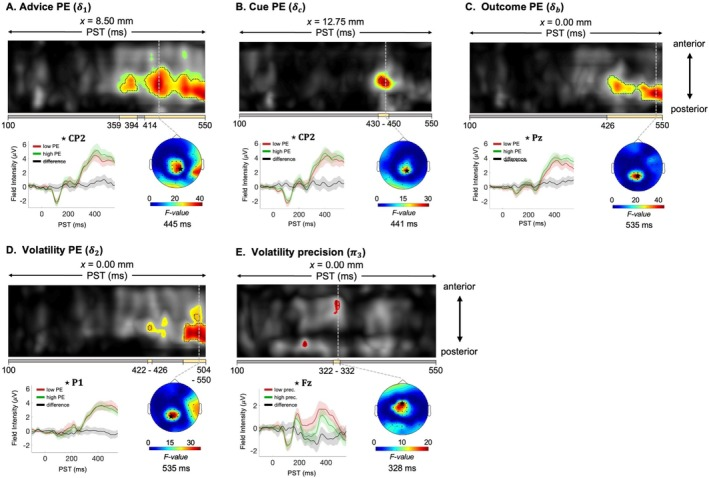
Understanding others’ intentions amidst uncertainty is critical for effective social interactions, yet the neural mechanisms underlying this process are not fully understood. Here, we combined computational modeling and single-trial EEG analysis to examine how the brain dynamically updates beliefs about others’ intentions in volatile social contexts. A total of 43 healthy volunteers engaged in a deception-free advice-taking task, featuring alternating stable and volatile phases that systematically manipulated the reliability of an adviser’s intentions. Using the hierarchical Gaussian filter (HGF), a Bayesian model of learning, we quantified trial-by-trial updates of participants’ beliefs and their neural correlates. EEG amplitudes systematically varied according to task volatility, engaging neural regions associated with uncertainty processing such as the fusiform gyrus and posterior cingulate cortex. Sensor-level EEG analyses confirmed a temporal sequence consistent with the hierarchical computations predicted by the HGF, whereby lower-level prediction errors were processed earlier than higher-order volatility-related signals. Moreover, individual differences in these hierarchical neural processes correlated significantly with psychosocial functioning, suggesting that disruptions in Bayesian belief updating may underlie functional impairments in clinical populations. Collectively, our results reveal novel neural evidence for hierarchical Bayesian inference during social learning, highlighting its critical role in adaptive social behavior and potential relevance to mental health.